
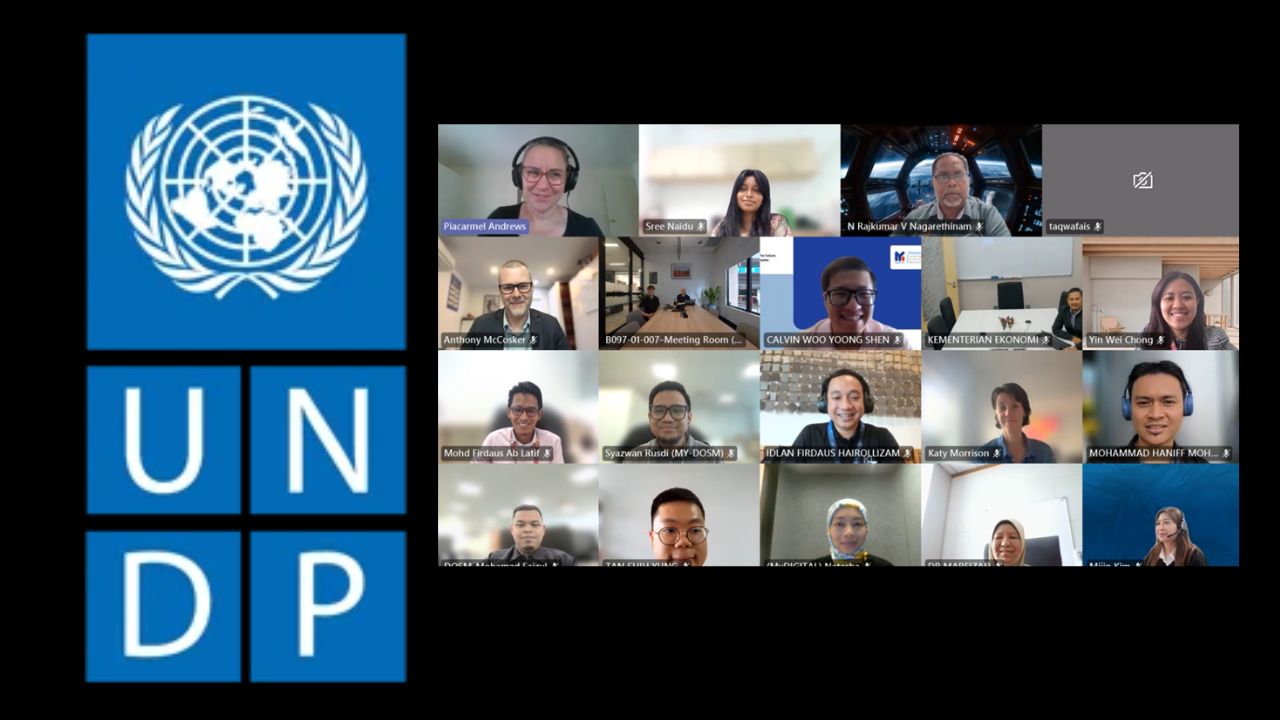
On Tuesday 25 November 2025, researchers from the Australian Digital Inclusion Index (ADII) partnered with the United Nations Development Programme (UNDP) Malaysia to deliver a virtual knowledge-sharing session for senior officials across UNDP and the Malaysian Government working to design the country’s new national digital inclusion index.
Hosted by UNDP Malaysia, the session Learning from Australia’s Digital Inclusion Journey brought together more than 40 participants from key national institutions, including the Ministry of Digital and MyDIGITAL Corporation, the Malaysian Communications and Multimedia Commission, the Department of Statistics Malaysia, the Ministry of Economy, the Ministry of Communications, the Implementation Coordination Unit in the Prime Minister’s Department and the Personal Data Protection Department, alongside UNDP staff.
ADM+S and ADII were represented by Distinguished Professor Julian Thomas (RMIT University), Professor Anthony McCosker (Swinburne University of Technology), Dr Kieran Hegarty (RMIT University) and Katy Morrison (RMIT University). The session was facilitated by Yin Wei Chong and Piacarmel Andrews from UNDP.
Sharing Australia’s experience with a national digital inclusion index
The workshop focused on how Australia has used the ADII as a long-term evidence base to track digital inclusion, inform social policy and guide infrastructure and skills investments. Distinguished Professor Thomas highlighted how the Index has had to evolve over time to remain relevant to policy: “What we’ve found is that we always see new technologies, new challenges and new ways of measuring things better”.
From evidence to policy impact
Participants were particularly interested in how ADII findings have been translated into concrete policy and program interventions. The ADII team discussed examples where the Index has helped:
- Target state and territory investments in telecommunications and internet infrastructure
- Support understanding of Closing the Gap Target 17 on First Nations digital inclusion through partnerships with First Nations organisations and communities
- Guide community and philanthropic initiatives such The Smith Family’s education programs and Good Things Foundation’s digital skills work
Professor McCosker also walked participants through new ADII questions on generative AI and hybrid work, illustrating how emerging technologies can be incorporated into an established framework without losing longitudinal value.
This discussion directly supports Malaysia’s work to establish its own national Digital Inclusivity Index Malaysia (DIIM), a flagship initiative being developed by MyDIGITAL Corporation and UNDP to monitor and address the country’s digital divide.
Strengthening international collaboration on digital inclusion
For the ADII team, the session marked a significant opportunity to share lessons from nearly a decade of digital inclusion research with peers in the region, and to learn from Malaysia’s own ambitions to design a comprehensive, whole-of-government framework for digital inclusion.
