

Theresa’s story: patchy coverage, mobile work and additional stress and labour
Every afternoon, Theresa pulls over at the top of a hill outside town to submit her timesheets. She’s a community nurse in a regional health network in South Australia, responsible for visiting older residents in their homes across a wide area. Between client visits, she needs to check rosters, record case notes and update the system to confirm completed appointments. But mobile coverage in the area is patchy and unreliable, especially in the more rural parts of her route. On days when she can’t get a signal, she takes photos of her handwritten notes to upload later and tries to remember to call in updates once she’s back in range. It’s frustrating, time-consuming and makes an already demanding job harder than it needs to be.
Most regional Australians now rely on connectivity that works most of the time. Daily internet use is the norm, and most households combine a home broadband service with mobile to get things done at work, school and home.
But not everyone, including people like Theresa, shares this experience yet. 15.9% of Australians report ‘always’ or ‘often’ having their mobile or internet use impacted by connectivity issues or network interruptions. Rates are much higher in regional and remote Australia—up to 30.5% in very remote areas (see Figure 1).
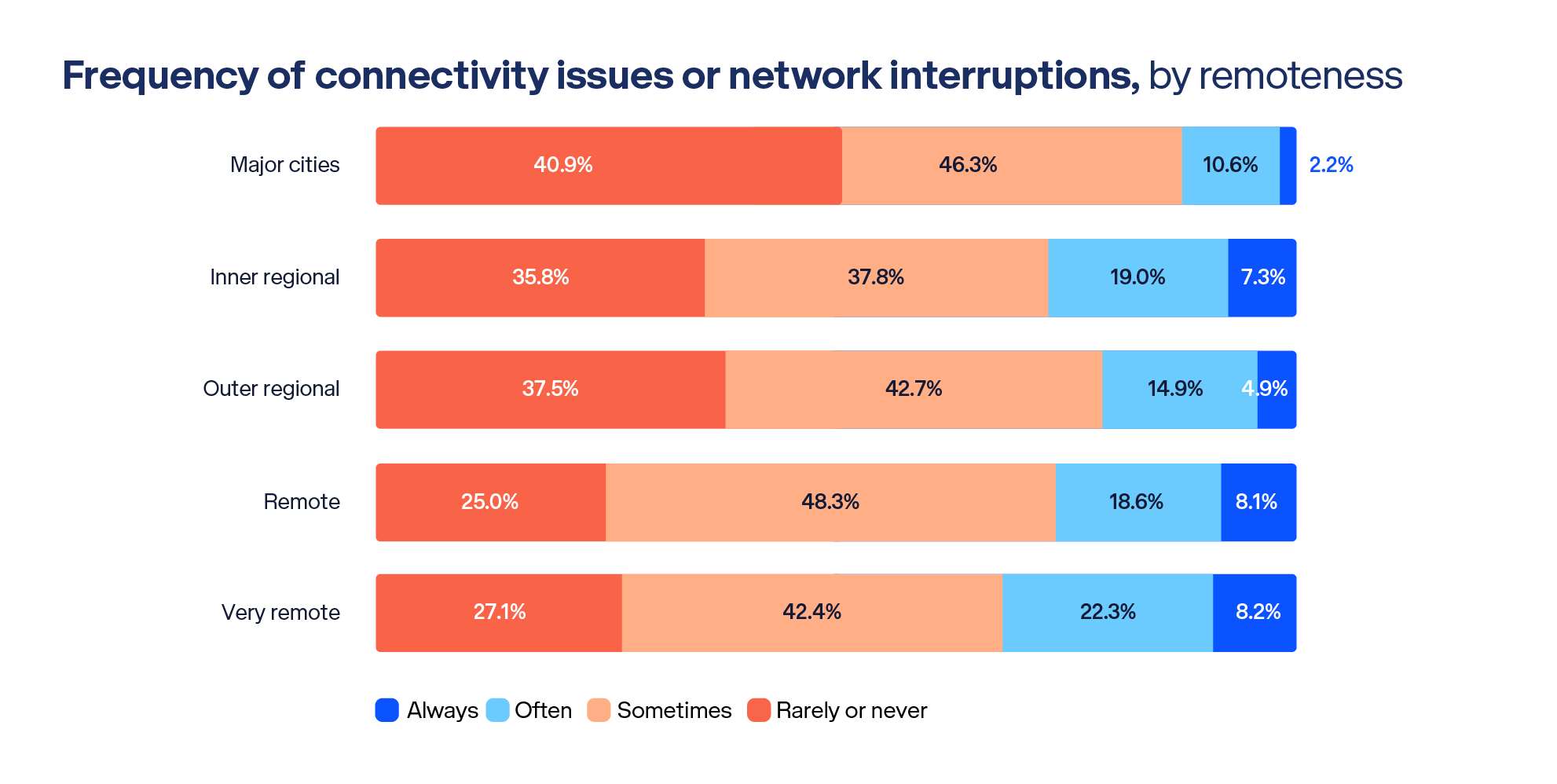
Figure 1: Frequency of connectivity issues or network interruptions, by remoteness (Source: Australian Internet Usage Survey, 2024).
Access to reliable, high-quality digital infrastructure across Australia’s diverse geography remains one of the most persistent challenges to achieving digital inclusion. In regional and remote areas, connectivity is often slower, more expensive, less reliable and more limited in provider choice.
Digital inclusion scores generally trend downwards with remoteness, with social and economic disadvantage compounding exclusion. Access gaps are particularly pronounced, with a 21 point gap between major cities and very remote Australia (see Figure 2).

Figure 2: Overall ADII scores and dimensions, by remoteness (source: 2025 Australian Digital Inclusion Index)
Affordability scores are lower in areas outside major cities. 21% of households outside capital cities had to compromise on the speed and/or data allowance of their internet connections in order to afford them, compared with 18.7% in capital cities. These rates are particularly high in remote (27.4%) and very remote (37.1%) areas. 14% of people in very remote areas regularly (‘often’ or ‘always’) have to sacrifice or cut back on essential household costs (like food or bills) to be able to afford personal or household internet access.
These gaps have significant implications, not only for individuals, but also for the broader social and economic development of non-metropolitan Australia.
Will upgrades and LEO satellite services close the urban-regional digital divide?
Emerging technologies, particularly LEO satellite services such as Starlink, have started to make high-speed connectivity available to areas previously reliant on slower and less reliable geostationary satellite services. Meanwhile, existing government policies and programs continue to support improvements in availability, speed and resilience.
However, cost remains a real barrier for low-income households. Without dedicated measures to achieve affordability, the benefits of newer infrastructure will be out of reach for many.
What are the consequences of the urban-regional digital divide?
The 2025 results show how place continues to shape digital inclusion. Despite significant policy action, network upgrades and the availability of new services, Access, Affordability and Digital Ability are all lower outside capital cities. Network interruptions are also more frequent outside of cities. Households in remote and very remote areas are more likely to rely on constrained plan types and to forgo other essentials to maintain connectivity. This illustrates that, despite the deployment of new infrastructure and the availability of new services, many in regional and remote areas still don’t have access to connectivity that meets their needs.
The ADII will continue to track how the deployment of new infrastructure and services are impacting the experience of connectivity in regional and remote Australia and what additional measures are needed to ensure everyone can benefit from developments.